Explore UAE > Dubai
Dubai Education Intelligence
دبي
Competent Authority: Knowledge and Human Development Authority (KHDA).
Readiness intelligence for Dubai private schools: 28 KHDA controls, 20 of them traced to gazetted texts on the Dubai Legislation Portal (source confidence A) and 8 held at confidence C pending confirmation, plus 15 federal requirements from federal law and Ministry instruments that no KHDA requirement already covers (added 19 September 2026).
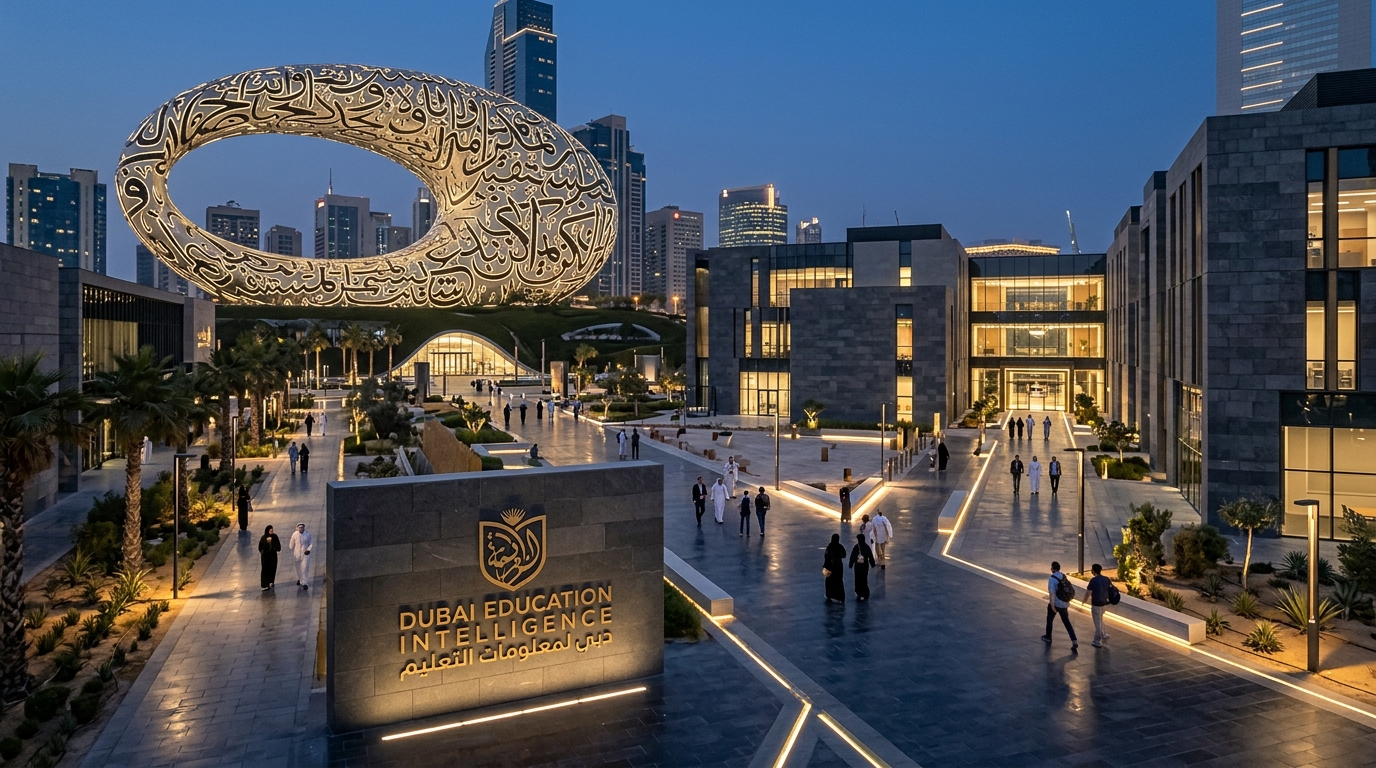
Seven Facets of Education Intelligence
Dubai Jurisdictional Profile
Organized under the seven core education intelligence dimensions: Schools, Authority, Information, Heritage, Opportunities, Updates, and Community.
Extensive Multi-Curriculum Breadth
Dubai hosts one of the most culturally diverse private school ecosystems globally, operating across multiple international curricular frameworks under a single unified inspection regime.
Every curriculum adapts to Federal baselines in Arabic Language, Islamic Studies, and UAE Social Studies while preserving international university entrance accreditation.
National Identity & Cultural Anchor
Preserving authentic Emirati character, moral education, and Arabic linguistic excellence within an international setting.
- Arabic Language Excellence: Structured evaluations for native speakers (Arabic A) and non-native learners (Arabic B).
- Islamic Values & Heritage: Embedding community responsibility, tolerance, and historical consciousness.
- Social Studies & UAE Culture: Active engagement with Emirati history, geography, and national traditions.
Experiential Horizons Across Dubai
Learning extends beyond the classroom walls through world-class public and cultural institutions.
Governed Collaboration Networks
Uniting school leaders, inclusion champions, and educators in disciplined communities of practice.
Shared intelligence across Dubai private schools allows operational compliance insights, evidence architectures, and safeguarding standards to compound rather than stay trapped in institutional silos.
Governed under KHDA educator professional ethics